



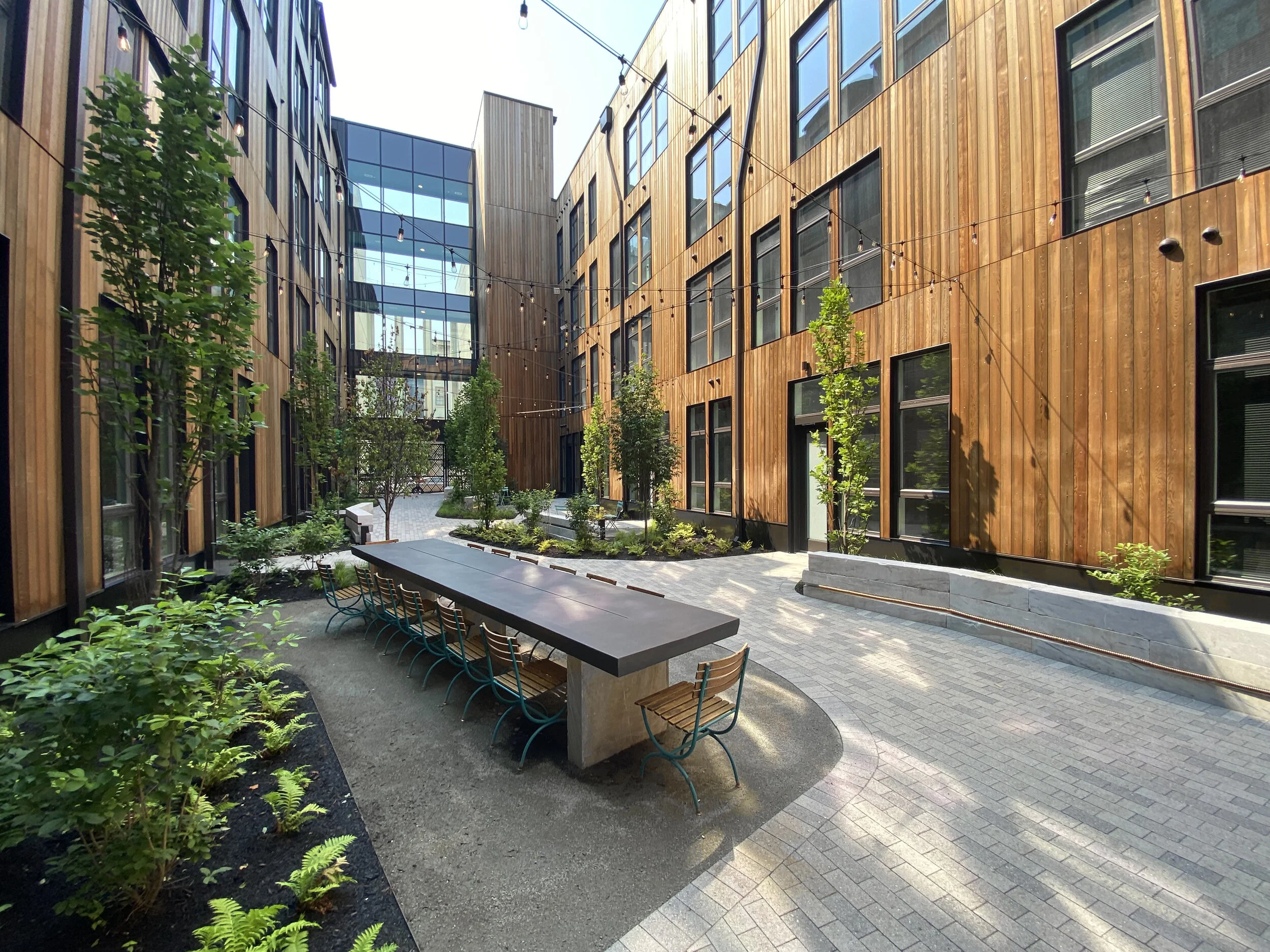

Opus Spicatum: A History of Herringbone

For as long as I can remember I have been buildings things. Long before I was a Landscape Architect, my brothers and I would create endless cities of wooden blocks across my parents living room. My grandfather would craft these out scrap oak in his wood shop - I can still the smell of mineral spirits and saw dust. I remember the wood floors in parent’s house outside of Chicago and the comfort of running my hands across the worn surface. The sun would stream through the double hung windows, bringing the wood grain to life and cast dark shadows in crevasses between the interlocking boards. We would emulate these patterns in the fortresses that we build…and inevitably destroy. We learned that the ultimate height of the towers and the city’s ability to withstand oncoming barrage greatly depended upon how the structures were built. We found that successful structures greatly relied on a sound base and interlocking joints. I had no clue about interlocking units or what pattern was at the time. But eventually these experiences would launch me into an intense curiosity for material, pattern and built environment.

Throughout the course of history, human development has dramatically shaped the built environment into an ever evolving network of pattern. These patterns of development can inform us of how past civilizations expanded, traveled and communicated across their empires. Ancient civilizations possessed amazing comprehension of geometric pattern, natural resources, and construction methods - these combined made the building blocks of the world’s first civilizations. These civilizations often looked to nature for inspiration.

The Ancient Egyptians were the first great innovators. They harnessed the enormous power of Nile with farming and irrigation techniques. They were fantastic architects and textile makers, and the first civilization to truly understand mathematics and the geometry of design. The Egyptians used their understanding of geometry to survey land, construct the great pyramids, and explore the heavens through astronomy.

The Egyptians were relied on the Nile River Delta for sustenance and studied the regularity in the natural world. They found beauty in the complexity of the flora and fauna of the Nile and found within it 17 simple geometries. All two-dimensional patterns in the known world stem from these 17 groups. The Egyptians transformed these geometries into rich tessellations. Egyptians adorned their architecture, textiles and clothing with colorful patterns that reflected their environment. The first known record of the Herringbone pattern can be traced to the Egyptian Pattern Language. This pattern of interwoven chevrons can be found in Egyptian textiles and metalwork. We find the pattern in the clothing and jewelry of Ancient Egyptian Kings.

The Egyptians were also brilliant problem solvers. In order to build their cities and construct the Great Pyramids they had to find the material to build them. Most of the pyramids were built with what the Egyptians called ‘Whitestone’, or low to mid grade limestone, alabaster, and basalt with the latter two being used more sparingly. Around 4,600 years ago, The Egyptians constructed the first road in known history to connect basalt quarries near Lake Moeris to the pyramids in Giza.

To construct this road, the Egyptians first quarried dimensional stone to make a crude road base and then filled the joints and covered the stone surface with sand to provide a smooth rolling course. They used logs to roll the massive stones to Giza– this road still exists today (see below).

Like the Egyptians – The Romans were also skilled architects, craftsmen & civil engineers. They invented Concrete and constructed a vast infrastructure of aqueducts to bring freshwater to their city centers. In order to maintain such a massive empire – they were also had a fantastic army. This Army was extremely effective because the Romans developed an Expansive Road System called Viae Publicae, or Public Road. This arterial transportation system allowed for accelerated communication and rapid transport of people and materials from one end of the empire to the other.
From around 500 B.C. onward, the Roman Empire developed the Viae Publicae as the arteries of their empire. Much Like the Egyptian Quarry Roads, the earliest Roman Roads were simple stone beds. First using rounded and tumbled stone from stream and river beds called cobble. These cobbles were arranged in a natural ashlar pattern firmly supported by crushed gravel and curbstones. These stone beds would then be covered with dirt as a wearing course and traction for horses. As quarrying techniques and skilled slave labor became more readily available the roads were refined to have exposed paving systems in areas of heavy use. A variety of patterns were developed for different purposes and varied widely from one end of the empire to the other depending on the skill of the craftsmen and material availability in the region.

This simple set of rules for roadway construction, prescribed by Vitruvius’ road bed section, evolved into tessellated interlocking paver systems firmly supported at the edges by curb stones and a substantial base of crushed stone that stretched 50,000 miles. Despite advancements in technology and construction, these basic principles of paving systems remain intact to this day.

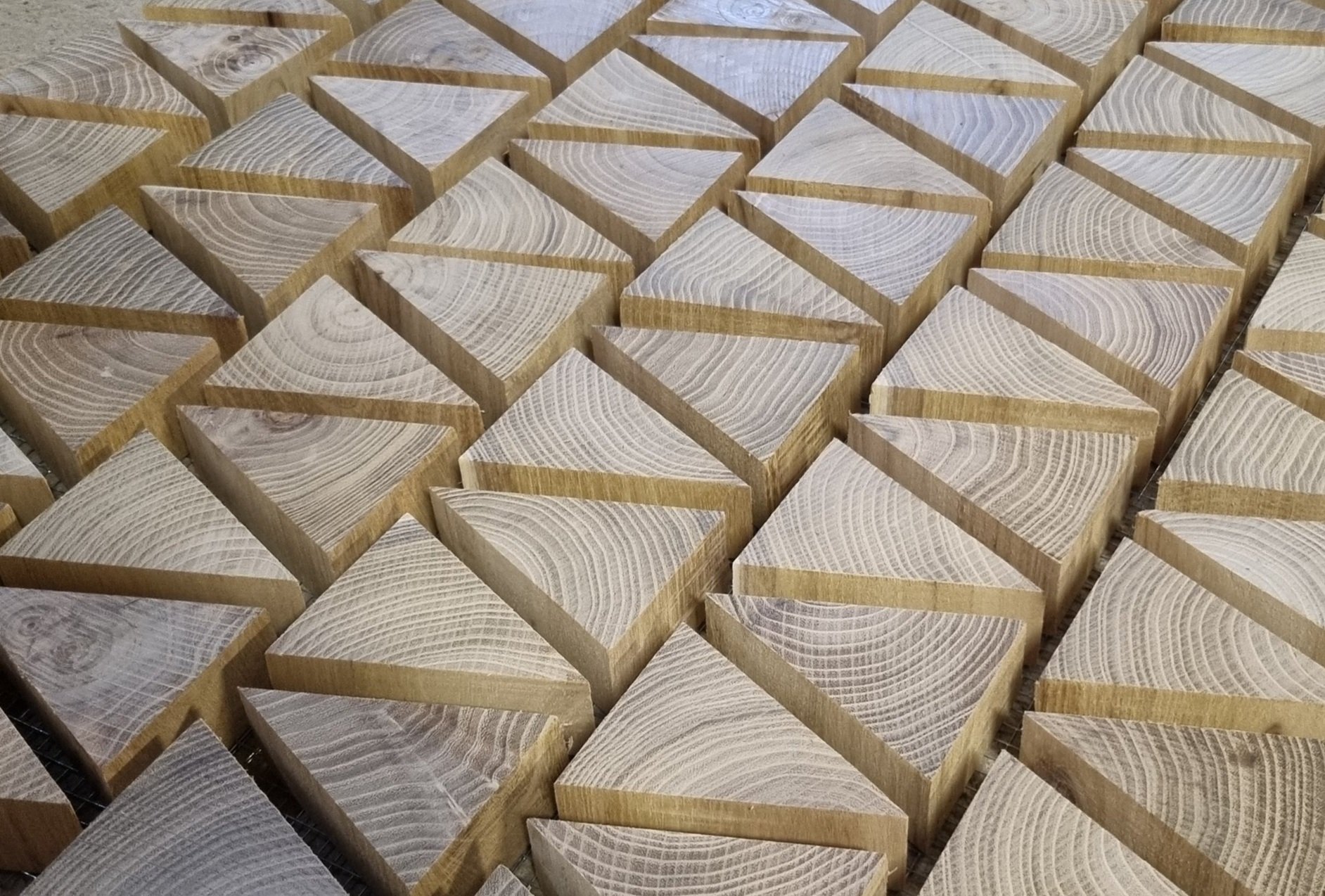
Herringbone as a paving pattern was developed during the Roman Empire. The stone masons called it ‘Opus spicatum’ or spiked work. The fairly simple pattern is distinguished from a plain chevron pattern by a break at the ‘arris’, or point of reversal, creating an intensely strong geometric matrix of interlocking units. I like to explain the difference between with the Chebron logo - If the big oil company would have named their company Herringbone rather than Chevron it might look something like this….notice the break at the arris.

When the chevrons are pointed in the direction of traffic the pattern becomes extremely strong under compression as the chevrons are able to spread the load over twice as many bricks. This inherent ability to absorb compression of movement makes it a remarkably resilient paving pattern. Stonemasons and laborers liked to use opus spicatum because they could lay stones much smaller than other patterns.


After the fall of the Western Roman Empire, many of the fundamental construction techniques of classical antiquity were lost and forgotten. Herringbone resurfaced again during the Renaissance in Europe. At this point the herringbone bond was taken from the horizontality of landscape and began to find itself in the motifs of architecture. The pattern became the fundamental backbone of Brunelleschi’s great Duomo in Florence. By incorporating the interlocking pattern into the structure of the dome, much like keystones in an arch, Brunelleschi disposed of the need for a central support system. The interlocking system gave the dome its unique shape and allowed it to defy the rule of ‘quinto acuto’, or acute fifth, which was a mathematical concept that was used to define the curvature of architectural domes previously.

We can learn from the history of herringbone as it teaches us that the most effective design solutions to complex design obstacles often arise from the lessons learned from those before us. I believe that designers must be committed to understanding material and pattern and their application in the built environment. This understanding fuels the inherent contextual and vernacular design solutions that are associated with the complex systems in which we work. Additionally, patterns and material are symbolic, like a flags, and have the potential to evoke a sense of place.

In Downtown Los Angeles, OLIN created a multi-modal transportation hub at Union Station tied to the history of the native people through the use of multicolored polychrome bricks. The plaza is orchestrated in a durable herringbone that is inspired by the colors and patterns that adorn the baskets of the Chumash Indians tribe. The Chumash created arguably the most refined and sophisticated exquisite baskets, some in herringbone pattern, found in the world. These baskets were hand woven out of twigs, bark and roots of local plants in very tight patterns that make for sound structures.

More recently, OLIN completed Simon and Helen Director Park in Portland, which incorporates a modified elongated herringbone pattern with two unique surface finishes in beautiful blonde granite. The paving, like a fine carpet, stretches from building face to building face, providing a continuous fabric that stitches together the built environment.

I believe as designers we must understand the importance of place and the value of building on time tested techniques - as they are often the most logical solutions. Much like the Great Egyptians and Romans, this knowledge can minimize entropy and ensure our built environments last for generations to come.
Philadelphia’s Renascmiento: The Action Plan for the Benjamin Franklin Parkway
I had the opportunity to attend the ‘More Park:Less Way’ unveiling at the Academy of Natural Sciences last night. The first hour was your typical back slapping routine by city bureaucrats while the audience fidgeted and awkwardly awaited the arrival of the Mayor…but some interesting things have come to the surface…unfortunately many of the infrastructural and traffic engineering solutions were not addressed. As some of these projects move forward, I hope these engineering solutions can be resolved hand in hand with the development of public open space with the primary focus on the pedestrian realm.

OLIN’s influence was felt throughout the evening with photos depicted, many mentions, and even the cover page of the plan. Throughout the presentation our projects, and a few others, were praised as major milestones in the Parkway Renaissance including the Barnes, Rodin, Logan Square & the Sculpture Garden. You could feel the positive energy and the excitement in the room as the Mayor, Deputy Mayor, Project Managers, and Harris Steinberg praised the parkway and its recent successes as the most transformative period in the history of the Parkway since its conception a hundred years ago - A true Renascimento.

Most of the presentation was focused on how to reconnect The Parkway to the 70,000 residents of the adjacent neighborhoods and make it a place where Philadelphians want to be. Harris Steinburg quoted Laurie when he said Paris didn’t build parks for its’ tourists - but rather Parisians built the Champs-Elysees for itself. If you want great tourist places, you have to build them first as place itself. The proposals of this plan are about edge conditions—whether that of neighborhood, a ball field, an apartment complex, a museum, etc.

Harris proposed four substantial open space improvements that could encourage pedestrian activity along the Parkway as both tourist connectors and a neighborhood destinations.
· The first, and probably most substantial, is Eakins Oval. As we all know this is a desolate 7 acre space (larger than Rittenhouse Square) that is nearly impossible to arrive at without jay-walking. The plan proposed to demolish the parking area (cue an outburst of applause) and create an ‘urban piazza’ and a series of curvilinear paths that would accommodate desire lines through the space. This is envisioned as a multifunctional space that incorporate all of the many programmatic requirements of the parkway…but ultimately would be ‘The Stoop’ of the Museum. I questioned some of the paths that were drawn and some that weren’t drawn. The was some awkwardness in the lines that could be refined but the idea of programmatically engaging Philadelphia’s third great traffic circle, behind Center Square and Logan square, is alluring one.
· Another space that the plan found as underutilized was the scraggly lawn around the Iroquois sculpture by di Suvero. Much like Eakins, this space has become landlocked and isolated by the autocentricity of the Parkway. The space is envisioned as a neighborhood amenity that is about ‘the Edge’ - a place for people to escape the neighborhood and enjoy the lawn. Re-envisioning the edge with areas of shade and seat with views to the central lawn - an oasis in front of the Philadelphian and a respite from Pennsylvania Avenue. This project would include the realignment of PMA with the Perelman and the reconfiguration of Pennsylvania Avenue parking, etc.
· The edges of Von Colln field were also discussed as areas of opportunity to reinvent the edge. Places where people could sit and tilted plans and enjoy the athletic fields and other areas where yoga and other active lifestyle activities could occur. A splash pad at the southwest corner was proposed as compliment to Swann & the Sister Cities interactive fountain.
· Finally, the open space in front of the Park Towne Place was portrayed as a series of outdoor rooms where bocce, checkers, and urban chic playgrounds could occur - activating the front yard of the apartment complex that is continually being occupied by younger demographics.
I found Harris’ presentation to be informative and easily swallowed, yet at the same time vague, unrefined and mostly unresolved (as most master plans tend to be). I also thought it was interesting that there was little mention of improving the pedestrian experience on 21st and 22nd street over the Vine Street Expressway which currently is scary and somewhat desolate.
There are many opportunities within these broad stroke to create wonderfully crafted spaces that are rich in the Philadelphian tradition.
Bridging the Vine: How We Can Reconnect Center City North
For over a century North Philadelphia has been cut off from Center City. First by the Reading Viaduct in the 1890s creating the ‘Chinese Wall’ - a 10 block barrier between the two districts.
By 1960s, Robert Mitchell and Ed Bacon’s urban renewal efforts were in full force and the Vine Street Expressway dramatically exacerbated the physical barrier and furthered the perceived gap between the city and it’s northern edge. In order to make way for the 8 lane thoroughfare the highway engineers severed the viaduct from Vine St southward.
In 2008, as if we hadn’t learned from the Viaduct or the Expressway, the City of Philadelphia expanded the mammoth Convention Center westward - stretching three full city blocks. By it’s completion ‘The Wall’ between North and South had solidified. Some would think that massive barriers like these are only created during times of war and political unrest - Philadelphia planning proves that theory wrong. Not only was the neighborhood on the wrong side of the tracks (and a depressed highway) but the city literally turned it’s back to its northern neighborhoods.

The question arises is what is WE want center city’s northern edge to be in the future? Will we continue this trend of creating urban barriers and isolating neighborhoods? Do we possess the vision of mitigating the disastrous effects of apathetic city planning that has taken place over the last 100 years?
To make matters worse, a kitschy proposal for a new French- themed casino came across the wire late last year depicting a wonderfully tacky mega-block structure that would surely destroy the little connective tissue left in this isolated territory. Without a doubt this proposal would destroy the urban realm with drafty architectural caverns and limitless amounts of blank walls. Casinos function with their backs to the street and bring with them an autocentric clientele. Head down to the Delaware River and visit the uber modern Sugarhouse which has completely alienated it’s surroundings.
As we reinvent the Philadelphia in what is a self proclaimed Renaissance, the Reading Viaduct as being envisioned as pedestrian connector. I find it interesting that original barrier that started the disintegration of the Northern Edge of Center City is doing little in the proposed schemes to reconnect the two districts.
Philadelphia Oldest Market District struggles to find its footing. With all of the development happening around Market East will find a new identity. Let’s bring the Market back to Market. EE&K begins to speak to a plan to do so.
@MillRiverPark in Stamford - Construction from Above © willBELCHER
No Diving Stencil wins Feet First Philly Competition © willBELCHER
Sidewalks have been around for over 2500 years. One can find them in the remains of Pompeii and some of our earliest civilizations - many still exist today. Great architecture often overshadows sidewalks as to what makes great space. But I am convinced that it is the space between buildings - the social forum that make great public spaces. The Taksim in Istanbul, Las Ramblas in Barcelona, and even Chestnut Street here in Philadelphia are the places to go and people watch.
Philadelphia is an extremely ‘walkable’ city with some very ‘unwalkable’ footpaths. The sidewalk network is plagued with issues from over use, others from the root systems of its vast street tree network, but mostly from just bad construction.
When I moved to Philadelphia two years ago I was fascinated with the dynamics of the pedestrian experience in Philadelphia - a place where every step must be a careful one. Large pools form during rain events creating pools for birds and urban wildlife. Massive plane trees tower over the broken concrete below them forced under the tension of their mighty roots. Philadelphia wouldn’t be the city it is without people tripping over the bricks they walk on.
#Kitsch for the Nations Front Lawn #NationalMall © willBELCHER
Recent #SmokeytheBear #ForestFire Posters © willBELCHER


